Heatstroke:
What To Do If Your Greyhound Overheats
Updated on July 2, 2014

First, don't let it happen!
Don't take your dog out when it is really hot. Early in the morning or late in the evening are the best times to exercise. Forget about the middle of the day. When the sun is at its strongest, not only is the heat unbearable from above, but it is unbearable on your pet's feet! If you are out for even a short walk, take a spray bottle full of ice water along to keep your dog cool. It is important to get familiar with the signs of heatstroke in a dog. You may notice your dog's tongue turning blue, excessive panting, loss of energy, or the gums may become very pale. Normally we suggest taking your dog's temperature rectally. The normal temperature of your dog is 101.5. You will need to react quickly if your dog has a temperature over 103 degrees. If your dog's temperature is over 106 degrees its internal organs can be damaged. If you do not have a digital thermometer and Vaseline readily available, it's best to not waste time trying to find these items or trying to take the dog's temperature if it is not cooperating. If your dog is truly overheating, you have 5-10 minutes to start aggressive treatment or your dog may die.
It is very important to keep the number of your veterinarian, as well as a number to the closest emergency veterinary facility, programmed into your cell phone in the event that your pet is in distress. A veterinarian is usually best equipped to deal with heatstroke but it may be a good idea to ask them what their procedure is during a routine visit. Forget about subcutaneous fluids, your dog will be long dead by the time subcutaneous fluids would help. You should make it very clear to your vet that you want intravenous fluids as opposed to subcutaneous fluids. Using intravenous fluids is much more effective at getting higher volumes of fluid into te bloodstream and will have a much more immediate effect. Once fluids are being administered, other cooling procedures should begin immediately.
The best cooling procedure, and the one we utilize at National Greyhound Adoption Program/Dutton Road Veterinary Clinic, involves ice, and lots of it, water, towels, a thermometer, a large container and approximately three people.
Take a container and fill it about 1/4 high with ice and then add twice as much water. The mixture should be sloshy. Soak towels in the ice cold water.

Lay the dog on its side and place towels on top of the dog and between the front and back legs.


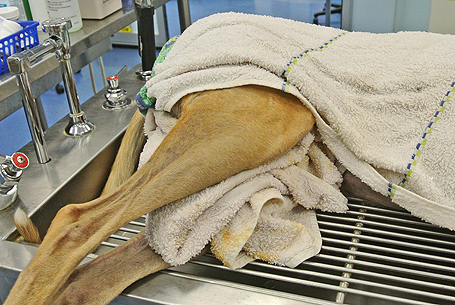

Speed is important. The towel will go from cold to lukewarm in 1 1/2 to 3 minutes as body heat comes off the dog. Someone may need to control the legs so that the dog does not struggle to stand and they can also spray rubbing alcohol on the pads to help with the cooling process.
If your veterinary facility is further than 5-10 minutes away, you will need to work quickly to lower your pet's body temperature using the same method above, minus the intravenous fluids, before you attempt to transport your dog or en route. In a situation such as this, it pays to be prepared. Several bags of ice should be kept available in a freezer. A large picnic cooler would be an ideal container to use and you can store your towels, a digital thermometer and some Vaseline inside. If you are driving somewhere for your walk, this kit can be transferred to your car as long as you are close to a facility that sells bags of ice. The only other thing you will need is a gallon of water which can remain in your car all the time. If you have a companion with you, that person can start treatment while you call your vet and drive your pet to the facility, even if they can just keep a cold towel on the body.
If you do not have a vet available, and have people at home that can help, you can perform this procedure at home. While the process of cooling down continues, be sure to take the dog's temperature about every 15 minutes. Use Vaseline to lubricate the thermometer before you insert it in the rectum. Often it may take an hour to get your dogs temperature in the normal range of 101.5. Your dog may shiver but that is normal. We have personally never seen a dog go into shock from this cooling procedure and the alternative is that it may die. You may get to a point when your dogs temperature begins creeping below the normal range in which case you take off the cold towels and replace them with dry towels whilst continuing to monitor the temperature. You will need to continuously monitor the temperature until the dog is stable.
If you are home alone and you feel your dog may be overheated but you are not prepared with the above supplies and you do not have a veterinary facility close by or a person that can assist you, you may be able to buy yourself some time, but not much, by putting your dog in the bathtub and continuously running cold water, as cold as you can get it, over your dog. Spraying your dog with a garden hose will not do. The water is not cold enough. In the meantime, try to contact help. Your first priority should be obtaining ice and starting the procedure described above.
Many dogs will die simply because they did not get appropriate treatment or because the treatment was done at too leisurely a pace. When we are treating dogs for heatstroke at NGAP/DRVC, we treat it as a true emergency.
Not too long ago, we had to perform this procedure on a dog that had been attacked by a cat. Although it was not heat related, it came in with a temperature of 106.6 degrees. We worked on the dog for an hour and a half to get its temperature below 103 degrees and probably went through the equivalent of eight bags of ice. The dog, because of the infection, had to be watched vigilantly for quite some time before we felt comfortable that it was stable.
We recently purchased some new equipment specifically for animals that have elevated or depressed temperatures. This equipment consists of a plastic pad, or blanket, which can be infused with cold or hot running water.

These blankets can be placed under and over the dog and will remain cold or hot, whichever we choose, throughout any procedure.


We still use ice cold towels to supplement these blankets for heatstroke cases but the blankets never have to be replaced because they are constantly being cooled by the internal refrigeration unit. These are particularly helpful to place underneath the dog where cold towels cannot be easily switched out.

If your dog is overheating and it is truly an emergency situation, you can call our clinic at 215-331-2968.
Planning ahead for heatstroke is of the utmost importance. If you think about it now and do nothing, you may be ill-equipped for the emergency. Several years ago, during an influenza scare, people were directed to store food and water in the event that they could not go out. I now have some 2-year-old canned chicken and peanut butter in the basement, but it's a small price to pay to be prepared.
Have a safe and happy summer!